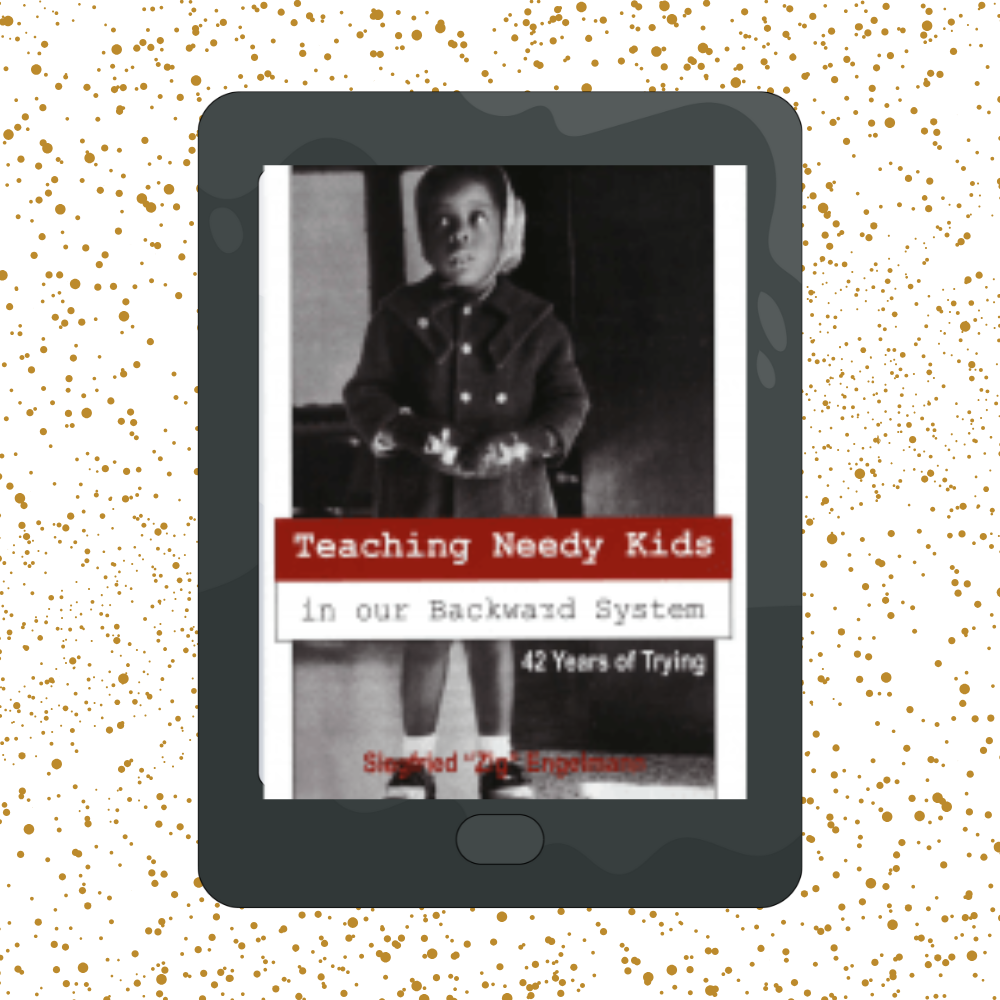
Available exclusively on Kindle; check your local Amazon site for details.
Free Downloads:
Table of Contents and Forward
Chapter 5
Teaching Needy Kids in Our Backward System documents the often outrageous experiences of a man some consider the most important educator ever, Siegfried “Zig” Engelmann. Through a tapestry of vignettes that span the 60s through 06, Professor Engelmann describes the battles he has fought to provide effective instruction for at-risk kids, particularly children from poverty.
The most incredible of Engelmann’s battles occurred in Project Follow Through, the largest and most definitive educational experiment ever conducted, involving 180 communities and over 200,000 at-risk children in grades kindergarten through 3. To discover which approach was most effective, Follow Through installed and tested 22 models of teaching disadvantaged children from 1968 to 1977. The models covered the spectrum of approaches in schools today, from discovery-oriented to those based on behavioral principles of reinforcement.
The evaluation measured the children’s achievements in reading, math, language, and spelling. The study was also designed to discover which models were superior in teaching basic skills and which excelled in teaching higher-order thinking skills, also which models had kids with the strongest sense of personal responsibility, and which kids had the highest self-images. The results astounded educators and made a mockery of their predictions.
There were not various winners, but only one winner, and that one excelled in every category measured. The winning model was designed by Zig Engelmann and his colleagues – Direct Instruction.
Why haven’t you heard about Follow Through, Direct Instruction, or Zig Engelmann? Because Follow Through outcomes were never disseminated, never made public, and never used to influence educational decision making. Why would the Feds spend half a billion to fund Follow Through and never disseminate the results? Read the book and discover the astonishing truths.
Author: Siegfried Engelmann
Copyright: 2007
ISBN: 9781880183007
Format: Hardback