

The History of DI Research
DI Programs are based on years of research on how children learn and the most effective ways to teach. This work produced the two basic principles of effective instruction:
- All children can learn when instruction is systematic, explicit, and efficient. Instruction must proceed in a logical and systematic fashion. Elements must be carefully sequenced so that students have the necessary preliminary understandings for new learning. The instruction must be presented very clearly to ensure that only one possible interpretation results from the presentation. These elements help ensure that it is efficiently designed and will teach the maximum amount of material in the shortest amount of time. With systematic, explicit, and efficient instruction, students can master material more quickly and become more self-confident learners. Direct Instruction programs, developed by Siegfried Engelmann and colleagues, incorporate all of these elements of effective instruction. The programs are developed through a careful process that involves extensive logical analysis of the subject matter and strategies for testing them before publication. These tests ensure that the programs are clear and explicit and present the material efficiently.
- Poor achievement does not result from poor students, but from poor teaching. All students can learn. When students do not learn, the problem is not with the student, but with the instruction. Poor achievement occurs when material is presented in a confusing, illogical, or inconsistent manner. Years of research on how children learn show that even minor alterations in instructional presentations can produce confusion and slow children’s learning. Direct Instruction programs include extensive guidelines for teachers on how to present material in ways that are logical, clear, and systematic, and that consistently reinforce children’s learning.
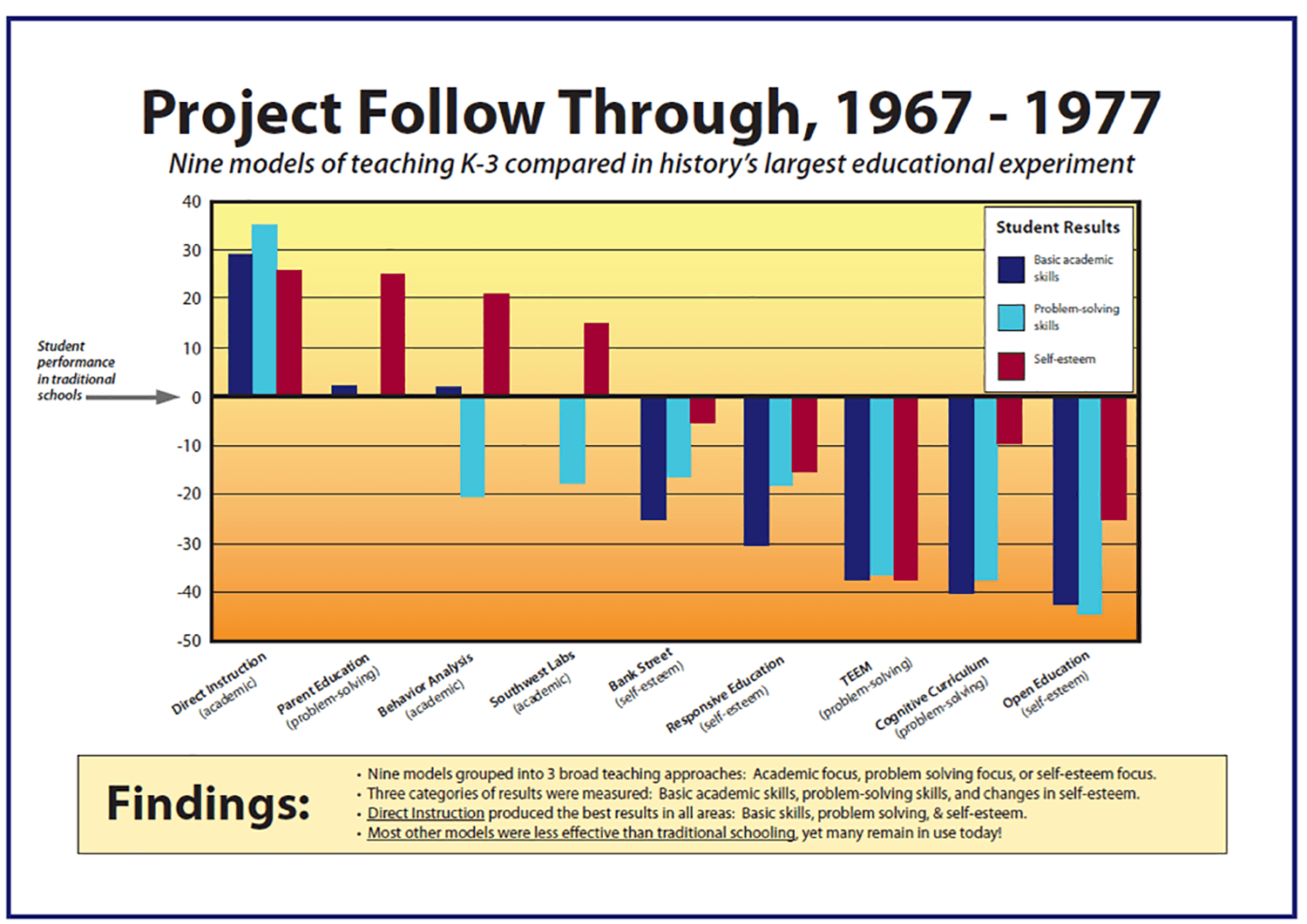
Project Follow Through, the largest educational experiment ever conducted, was the first large-scale documentation of DI’s superiority. Since that time, many studies across a wide variety of settings have shown that children who receive Direct Instruction achieve significantly higher, make more rapid educational progress, and have higher levels of self-esteem than students in other programs. Studies also show that as their students’ achievement increases, teachers who use Direct Instruction become more self-confident and assured of their professional abilities.
Beginnings
The origins of Direct Instruction lie in the genius of Siegfried Engelmann, who chose to study the process of learning and instruction from a new vantage point. In the early 1960s, Engelmann worked in advertising, where he began analyzing what type of input was necessary to induce retention. His work on these marketing strategies led him to develop techniques for teaching children, initially his own two sons. These early experiments led to the first Direct Instruction programs and techniques. Engelmann realized the relationship between what his sons learned and how he instructed them, and applied this knowledge to his work with the education researcher Carl Bereiter at the Institute for Research on Exceptional Children in Champaign, Illinois (1964-1966). In 1964, they formed the Bereiter-Engelmann preschool, where they would begin using and testing direct instruction techniques with disadvantaged children. While conducting this research, Engelmann developed the central philosophy of Direct Instruction, which states that if a student fails to learn, it is not the fault of the student, but rather the instruction.
Throughout the 1960s, Engelmann conducted research on the effectiveness of his instructional techniques and programs to better understand how children from different backgrounds and with varying skill levels learned. His experiments were designed to understand how to instruct children as efficiently and effectively as possible, and how appropriate instruction differs for children of different backgrounds and skills. Engelmann utilized a scientific approach to analyze each variable of instruction to determine the most efficient and effective instructional approach. Through his experiments, Engelmann determined that disadvantaged students had a deficit in language skills compared to their more affluent peers, which hindered their learning rate. This lack of language skills made the acquisition of reading skills more difficult, so Engelmann began focusing on developing language and reading skills in tandem. This research solidified Engelmann’s theory that students’ acquisition of knowledge and development of skills is dependent on the teacher’s appropriate instruction, which needs to be adjusted based on the child’s skill level. A teacher must recognize and understand the students’ skills as well as what type of instruction they need to progress and acquire new skills so they become confident and successful students.
Direct Instruction was designed to maximize the effectiveness and efficiency of instruction, while simultaneously recognizing students’ skill levels in order for them to receive the appropriate instruction to prevent them from being overwhelmed and falling behind the achievement of their peers. Engelmann determined that students must establish mastery of skills in order to progress in their studies, and therefore, students should be instructed in small groups based on skill level, as opposed to grade level. By establishing mastery, students can more easily progress to more complex areas of study because they will not need as much review of the fundamentals on which the new material is based. Additionally, by establishing mastery, students gain confidence in their skills and ability to succeed. Engelmann initially intended Direct Instruction to be used with at-risk students to allow them to learn more in less time so they could attain the same skills as their more affluent peers by the end of elementary school. By catching up with their peers by the end of elementary school, the at-risk students would have the confidence and ability to compete on a level playing field as they progress in school. The success of Direct Instruction is dependent on the proper placement of students into classrooms based on their skill level, the use of an appropriate academic curriculum, and adequate instruction from teachers. Engelmann’s philosophy of instruction and early research with young children would lead to the development of DISTAR in the 1960s, as well as all subsequent Direct Instruction programs.
Project Follow Through
What Was Project Follow Through?
Project Follow Through was a federally sponsored education study launched in 1968 to identify the most effective ways to teach at-risk children in kindergarten through grade 3. It involved more than 200,000 students across 178 communities, representing diverse geographic regions, racial and ethnic groups, and income levels. Families in each community selected the instructional model their schools would implement.
The goal was to determine which instructional approaches produced the strongest outcomes for students facing the greatest educational challenges. With strong federal funding, implementation support, and accountability measures, Follow Through was designed to be a rigorous, real-world test of competing educational models.
What Were the Results?
After nine years, the evaluation results were clear: Direct Instruction (DI) outperformed all other models. Students in DI programs showed significantly higher academic achievement, stronger self-confidence, and better long-term outcomes, including higher rates of high school completion and postsecondary participation. No other model produced comparable or replicable results.
The Findings Were Never Shared
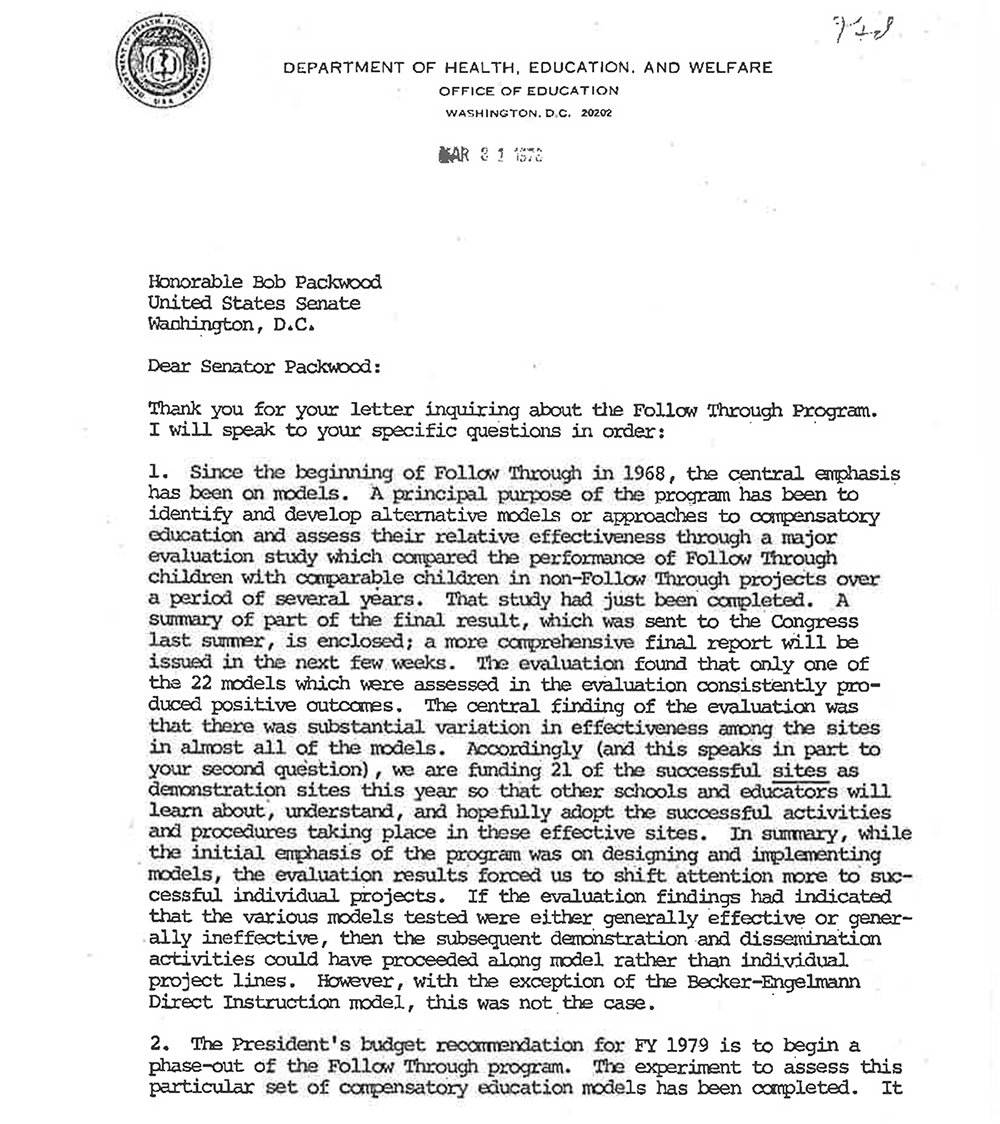
Despite the strength and consistency of the findings, the U.S. Office of Education chose not to disseminate the results. Although policymakers accepted the data as valid, the outcomes challenged prevailing educational beliefs. Rather than promoting the one model that consistently succeeded, all models were treated equally, and the most effective approach was not broadly shared with states and districts.
Project Follow Through remains the largest and most consequential educational experiment in U.S. history, and its findings continue to inform NIFDI’s work to promote evidence-based, replicable instructional practices.
Here is a letter from the U.S Commissioner at the time (equivalent to today’s Secretary of Education) explaining why the results of the evaluation were not disseminated:
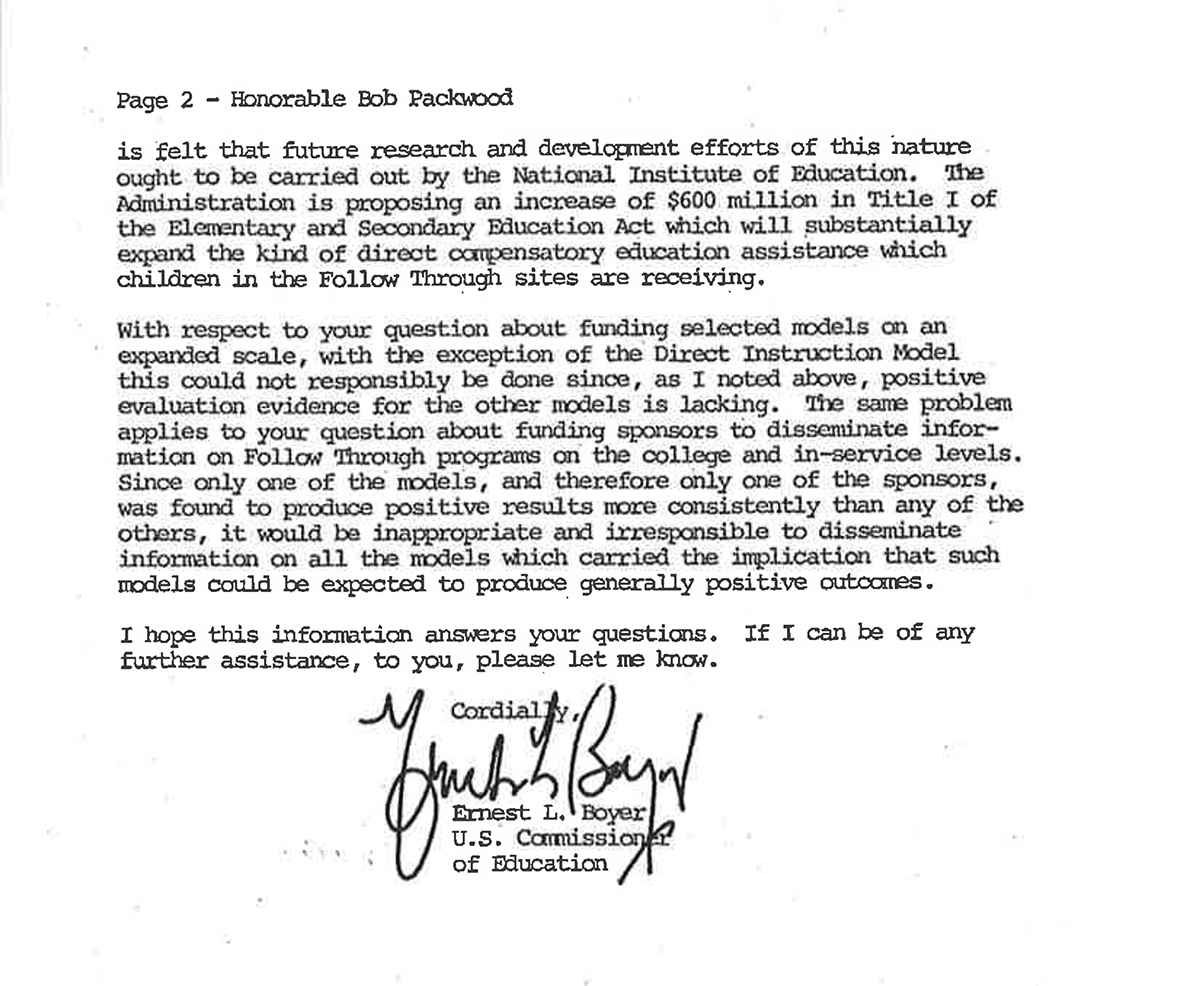
Siegfried Engelmann, Senior Author of the DI programs, provides a full description of the Follow Through experiment, the results, and the aftermath in his book, Teaching Needy Kids in our Backward System (ADI Press, 2007). Engelmann examines the Commissioner’s rationale for not disseminating the evaluation results in Chapter 5 (from pp. 250-51).
Additional Information
Athabasca University online module on Direct Instruction Evidence: Project Follow Through.
A special issue of Effective School Practices published in 1995-96 described Project Follow Through and its implications for current generations of students.
Shepard Barbash describes the design and outcomes of Project Follow Through in his book Clear Teaching.
A comprehensive bibliography of writing related to Direct Instruction and Project Follow Through.
Project Follow Through Playlist
1:29:59
1:03:42
1:05:08
1:15:55
Project Follow Through and Its Relevance Today
In 1967, the United States Department of Education launched the largest and most ambitious educational experiment in history: Project Follow Through. Its stated purpose was to discover which approach was best for teaching at-risk children from kindergarten through grade 3.
Veteran Direct Instruction author, researcher, and implementer Bonnie Grossen presented this webinar and provided insight into the outcomes of the project and the response to the findings.
Topics covered include:
- Goals and Origins of Project Follow Through
- Scope and Structure
- Results and Implications
- Critique and Lack of Dissemination
- Significance Today
Download participant materials here.
Original broadcast April 21, 2021
Progressively Incorrect Podcast S2E21: Marcy Stein on Engelmann’s Direct Instruction and Project Follow Through
Dr. Marcy Stein, professor emeritus and lead author of Direct Instruction Mathematics, joined Dr. Zach Groshell to talk about Project Follow Through and Zig Engelmann’s Direct Instruction programs.
Progressively Incorrect Podcast S3E10: Linda Carnine, Susie Andrist, and Jerry Silbert on What Was Project Follow Through?
Linda Carnine, Susie Andrist, and Jerry Silbert join Dr. Zach Groshell to talk about what it was like to be on the ground, in their 20s, in the largest education study in the history of education.
Chalk & Talk Podcast Ep 39: Project Follow Through: Direct Instruction’s Overlooked Success with Marcy Stein
Dr. Marcy Stein joins Anna Stokke to discuss her first-hand experiences with Direct Instruction and Project Follow Through.
Over 40 Years of Research
Scientific developments are based on carefully developed theory and rigorous empirical tests. The Direct Instruction approach to teaching exemplifies this tradition, with a strong theoretical base, the continual incorporation of research in program development, and hundreds of replications of research results. These results demonstrate the programs’ strong efficacy in varied settings and with different populations.
The theoretical propositions that underlie Direct Instruction are summarized and tested in books such as Conceptual Learning (1969), Theory of Instruction: Principles and Applications (1982), Inferred Functions of Performance and Learning (2004), and Could John Stuart Mill Have Saved Our Schools? (2004). These writings delineate the logical basis for DI’s basic principles that:
1) all children can learn when instruction is systematic, explicit, and efficient; and
2) poor achievement does not result from poor students, but from poor teaching.
They present the suppositions in formal logical terms, provide empirical tests of the theoretical propositions, and link the analyses to classic philosophical writings.
The development of DI programs is based on these theoretical principles and incorporates carefully designed research at all stages. DI authors pay particular attention to ensuring that the instructional programs are logical, explicit, and systematic, so they try out each element of a program to make sure it works. When students do not understand something, the authors assume that there is a problem in the program. They identify the problem, alter the instructional design, and then test it again. Once the instructional programs are fully drafted, they are field tested in schools around the country. The sites are carefully selected to represent varied demographic and geographical settings. Feedback from these sites is used to again revise the programs as needed. No other instructional programs use such careful research procedures, or such a fully developed theoretical base, in their construction and design.
Once programs are published and widely disseminated, scholars from around the world examine their efficacy. Over the last five decades, hundreds of studies of the efficacy of Direct Instruction have been conducted. These studies have involved all aspects of the DI curriculum, such as reading, math, language, and spelling. They have included students in rural, suburban, and urban settings; students from preschool to adulthood; students with all types of demographic characteristics and ability levels; and students in the United States and in other countries. The studies have used a wide range of designs such as randomized controlled trials, large-scale multi-site implementations, longitudinal studies, and single-subject designs. This research has consistently found strong evidence that students exposed to Direct Instruction have higher achievement than those using other programs.
Extensive literature reviews and meta-analyses summarize this literature. Bibliographic citations of much of this literature are included in NIFDI’s Comprehensive Bibliography of the DI literature. Substantial proportions of this research are also included in NIFDI’s searchable database of DI-related writings.