877.485.1973 ⎸ 541.485.1973
Info@NIFDI.org

Corrective Reading (2008)

Corrective Reading (2008 Version)

Corrective Reading is a powerful Direct Instruction remedial reading series that solves a wide range of problems for struggling older readers, even if they have failed with other approaches. Explicit, step-by-step lessons are organized around two major strands, Decoding and Comprehension, which may be used separately or together to customize instruction for particular student needs. Each strand of Corrective Reading has four levels that teach foundational skills for non-readers to seventh-grade-level material – potentially all in about 2 1/2 years.
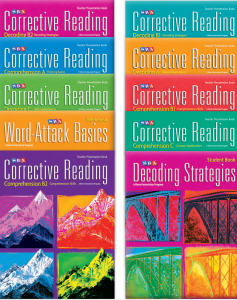
Corrective Reading is typically taught to students in grades 4 and above who exhibit misidentified words, confusion among similar words, omissions or insertions, lack of attention to punctuation, and poor comprehension. It is effective with students who have poor attention, poor recall of directions, or who meet the criteria to receive special services. With a high success rate, frequent teacher feedback, and built-in opportunities to earn reinforcement throughout each lesson, even students with histories of failure remain motivated and on task.

Decoding lessons range from instruction in letter sounds and blending to the reading of sophisticated passages found in content-area textbooks. Comprehension lesson skills range from simple classification and true-false identification to complex analogies, analyses, and inferential comprehension strategies. As students progress through each level, they read increasingly difficult material with accuracy, fluency, solid comprehension, and improved study skills. The program is ideally complemented by the Expressive Writing or Reasoning and Writing Direct Instruction programs.

Celebrating 50 Years of Corrective Reading Decoding

Join us in celebrating the 50th anniversary of Corrective Reading Decoding with this special video featuring Linda Carnine, co-author of Corrective Reading Decoding. In this exclusive interview, Linda shares her reflections on the program’s development, her experience as a co-author, and the powerful features that continue to make Corrective Reading Decoding an effective solution for helping struggling students become successful readers. As we mark five decades of impact, this video highlights not only the program’s history and purpose but also its lasting legacy in classrooms across the country. Whether you’re an educator, administrator, or advocate for evidence-based literacy instruction, Linda’s insights offer valuable context and inspiration.

Program Resources

Access placement tests and related documents.

Where to Purchase

Visit the publisher’s website for purchasing information.

Related Research

Learn more about the research behind this program.

Videos

View videos related to this program.

Interested in learning how to implement Direct Instruction in your district, school, or home? NIFDI can help. Click a button below to learn more. 

What is a Peer Coach?

Peer coaches play a critical role in sustaining strong implementation of Direct Instruction (DI) at the school level. Selected during the first year of implementation, peer coaches are classroom teachers who demonstrate strong instructional practice, effective communication with colleagues, and a willingness to support others. Because they teach the same programs as their peers, they bring practical expertise and shared experience that help build trust and collaboration across the school.

As implementation progresses, peer coaches extend the impact of NIFDI consultants by providing ongoing, school-based support when consultants are not on-site. Their coaching is non-evaluative and focused on improving student outcomes. Peer coaches reinforce effective teaching practices and guide colleagues to make targeted adjustments that directly impact student performance and behavior.

Peer coaches participate in a structured, multi-year training sequence through NIFDI. Over the course of two to three years, they are trained to analyze student performance data, conduct both brief and extended classroom observations, and support data-driven problem solving. Advanced training prepares them to lead grade-level meetings and contribute to broader instructional planning with school leadership.

By developing peer coaches, schools build internal capacity to maintain and strengthen DI implementation over time—ensuring continuity, supporting new staff, and driving sustained student achievement.